

Marimbas embody the vibrant intersection of cultures in Latin America
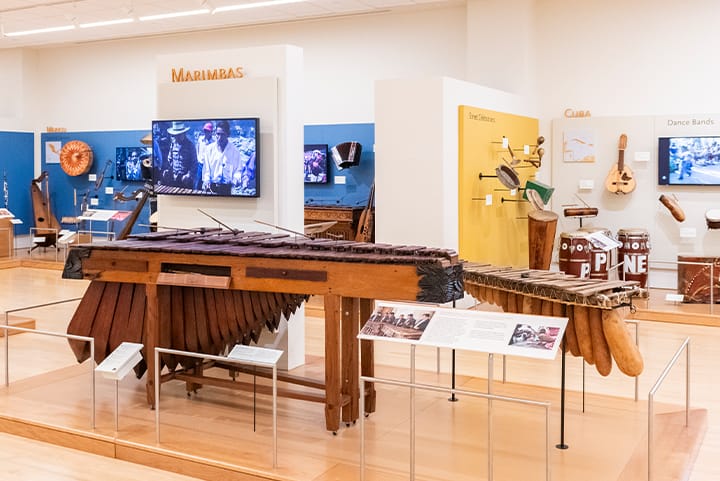
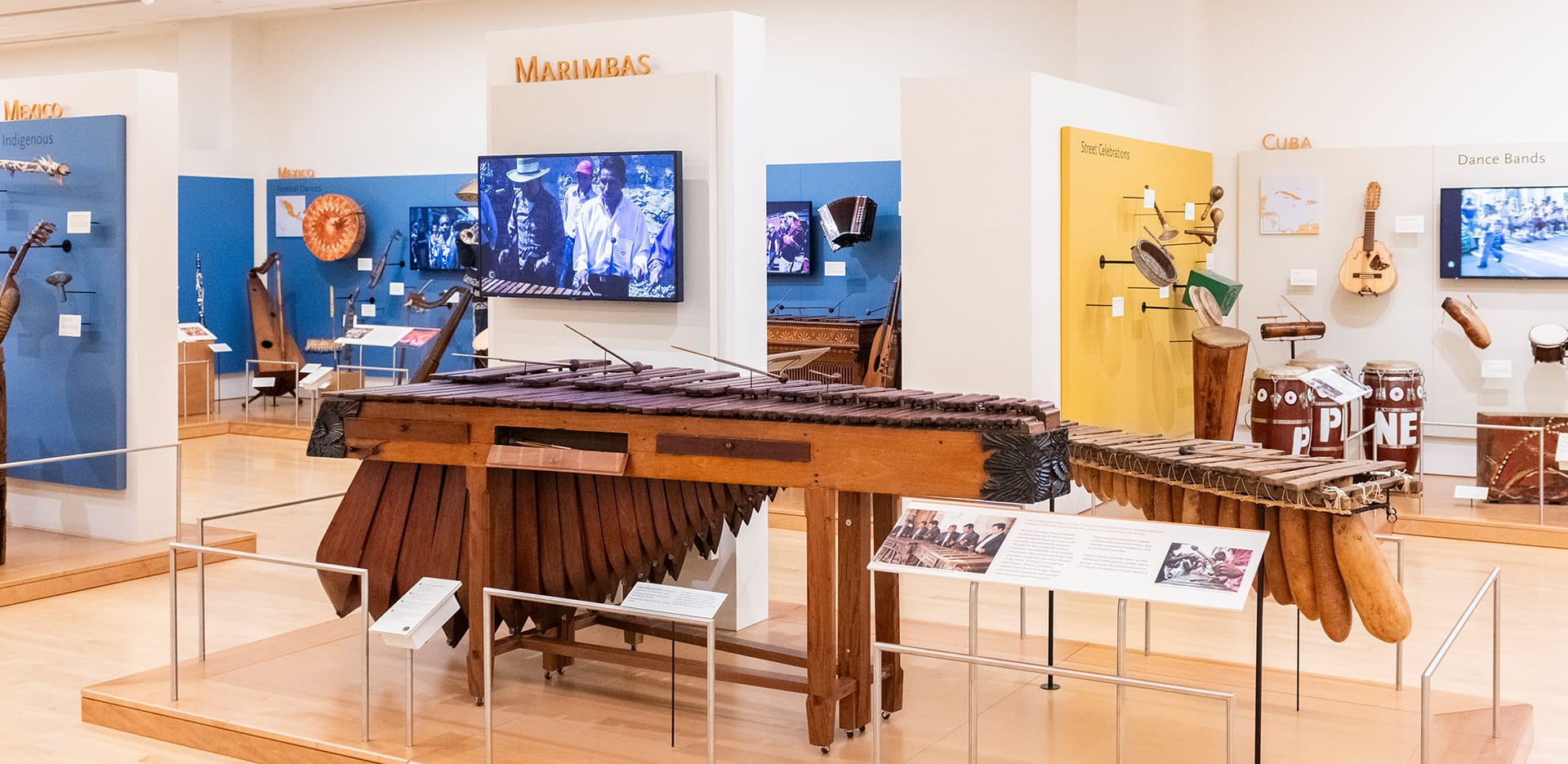
The Marimbas exhibit’s Guatemalan marimbas are displayed on an expanded platform in the Latin America and the Caribbean Gallery.
New acquisitions and a new exhibit in the Latin America and the Caribbean Gallery highlight the marimba, a versatile and popular instrument cherished throughout Central America and parts of Mexico, Colombia, and Ecuador.
The gallery’s new Marimbas exhibit traces the instrument’s history and development. The first marimbas were introduced to Central America by African slaves and adopted by Maya musicians in the 16th and 17th centuries. The Marimbas exhibit’s marimba de tecomates, made around 1920 by the Maya K’iche’ people of Guatemala, recalls the marimba’s African predecessors: it has a single row of keys, and its resonators are made from gourds—typical features for marimbas through the 19th century. Small membranes made from pig intestines are attached to the resonators with beeswax, and they make a buzzing sound when each key is struck. The wooden arc on the player’s side helped relieve the instrument’s weight as musicians supported the marimba on their backs, shoulders, or knees.
In the 1890s, musicians in Guatemala and Chiapas, Mexico, pioneered marimbas with longer double-row chromatic keyboards that allowed musicians—four of them, each with two wooden mallets—to play in any key. These marimbas had wooden resonators and were mounted on permanent stands, rather than being supported by the players. They later inspired the development of international variations, such as orchestral marimbas.
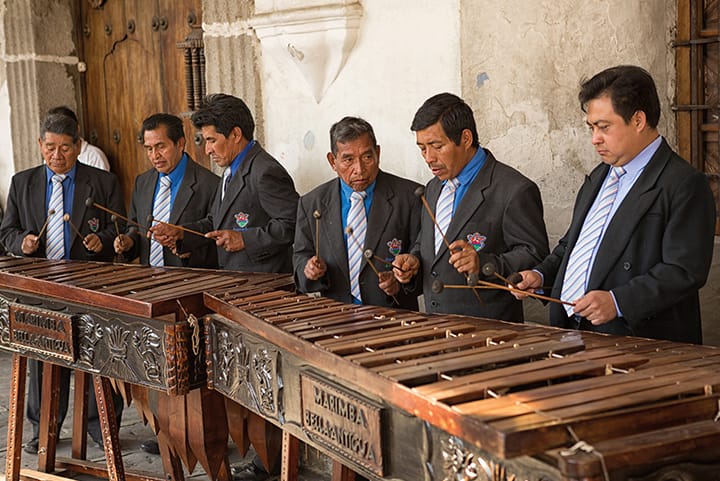
Musicians in Guatemala play in an ensemble with a marimba grande (right) and marimba tenor (left).
The newly acquired marimba grande in the Marimbas exhibit is an exceptional example of this type. The eight-and-a-half-foot-long instrument was made by Rosendo D. Barrios, who established a world-renowned marimba factory in Guatemala City. Barrios’s marimbas were the first of their kind to be introduced to the United States in 1908, and his instruments helped popularize marimbas in the United States and Europe. Barrios’s marimba grande maintains a tie to the instrument’s origins: pig intestine membranes are affixed to the resonators to achieve the preferred buzzing sound.
Another new acquisition in the Mexico exhibit complements the story of the marimba’s development. The exhibit’s new, nearly nine-foot-long marimba grande was built in Chiapas around 1932 by acclaimed Mexican marimba maker, composer, and musician David Gómez Solana, who in 1898 made one of Mexico’s first chromatic marimbas. MIM’s Solana chromatic marimba is one of two with a decorative wooden front panel that he custom-designed to play with his acclaimed ensemble Cuarteto Marimbístico de los Hermanos Gómez.
Diverse marimba types remain popular throughout parts of Latin America and are played in various musical contexts, from Indigenous villages to urban concert halls.
“The marimba embodies the vibrant intersection of cultures that is characteristic of Latin America,” says Daniel Piper, MIM’s curator for Latin America. “Already I’ve seen guests and school tour groups stunned by the addition of these two gorgeous historic marimba grande. These acquisitions lead guests into the fascinating story of a major instrument type connecting Africa, Latin America, and the United States.”

The resonators of the Guatemalan marimba de tecomates are made from gourds.