
See remarkable acquisitions in the Ukuleles, Hawaii, and Polynesia exhibits
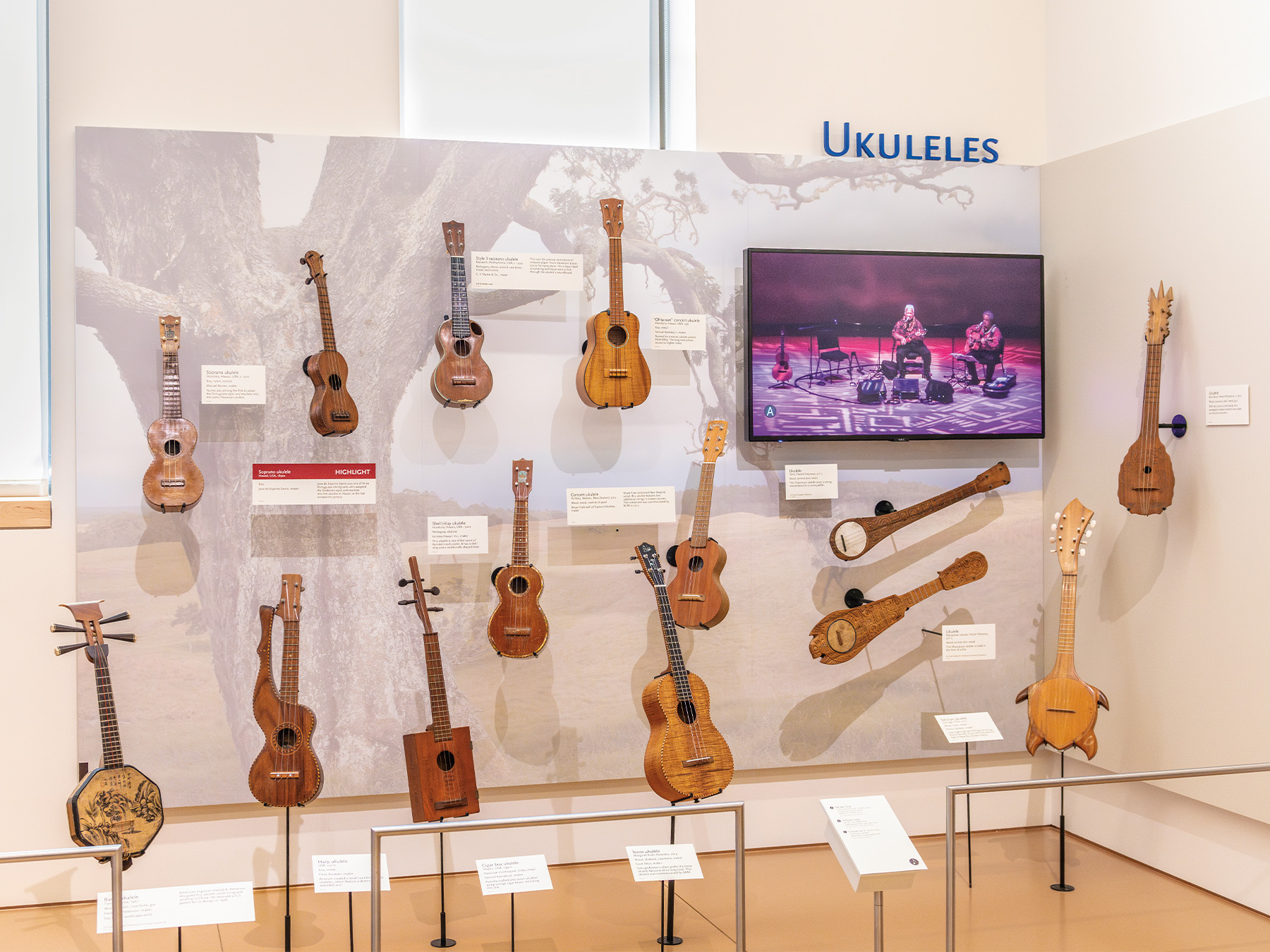
The revised Ukuleles exhibit in the Oceania Gallery now features a soprano ukulele made by Jose do Espirito Santo, one of the instrument’s inventors (top row, second from left).
New acquisitions on display in the Oceania Gallery offer deeper insights into musical traditions across Polynesia. Additions to the Ukuleles and Hawaii exhibits show how Hawaiians adapted European instruments and influenced American music, and new instruments in the Polynesia exhibit highlight some of the region’s Indigenous traditions.
The cultural region of Polynesia encompasses more than 1,000 islands—including Hawaii, Fiji, Tahiti, the Marquesas Islands, and many more—spread across a broad swath of the Pacific Ocean. These islands nurture diverse traditions but share connections in their languages, customs, and musical practices.
The ukulele is broadly associated with Polynesia, but it is an iconic instrument of Hawaii, where it was developed during the early 1880s by Portuguese immigrants who adapted it from Madeiran instruments such as the rajao and machete. One of the new additions to the Ukuleles exhibit is a soprano ukulele made in the 1890s by one of the ukulele’s three inventors: Jose do Espirito Santo. This remarkable instrument offers guests a direct connection to the ukulele’s origins.

This soprano ukulele was made in the 1890s by Jose do Espirito Santo, one of the ukulele’s three inventors.
Other new acquisitions in the Ukuleles exhibit include a 1920s ukulele made by Samuel Kamaka Sr., who founded the world-renowned, family-owned Kamaka Hawaii manufacturing company. One of the rarest of Kamaka Sr.’s early works, it is made of mahogany with beautiful abalone shell inlay. Next to it is a 1940s cigar box ukulele made by his son, Samuel Kamaka Jr.—one of only seven he crafted from vintage cigar boxes. Another addition is a 1910s harp ukulele made by well-known luthier Chris Knutsen as a novelty instrument with a distinctive extended arm that mirrors the design of his harp guitars. These instruments demonstrate how the ukulele gained popularity and inspired innovative designs during the early 20th century.
Across the Oceania Gallery in the Hawaii exhibit, a newly acquired and rare three-quarter–size guitar embodies the relationship between ukuleles and guitars. The instrument was made by Leonardo Nunes, who crafted it following the construction methods of his father, Manuel Nunes, another of the three original Portuguese ukulele makers.
Other new additions in the Oceania Gallery are emblematic of Indigenous Polynesian traditions that have endured for centuries. Three 19th-century instruments added to the Polynesia exhibit highlight musical practices that appear across the region, each with distinct elements that exemplify their traditional forms. The exhibit’s davui conch shell trumpet from Fiji, which is ornamented with finely braided coconut fibers, was traditionally used to sound the war cry. The pū shell trumpet (below) from the Marquesas Islands of French Polynesia would have been used in war and in ceremonies related to sacred sites—the human hair on it would have come from enemies or relatives. And the Fijian lalinivalu slit drum, marked by chevrons carved along its rim, was traditionally used to signal significant events such as wars, births, and deaths.

“Polynesia is a vast geographic region shaped by dynamic interplays of Indigenous traditions, interisland exchange, and European influence,” says Eddie Chia-Hao Hsu, curator for Asia and Oceania. “With these refreshed exhibits, we hope to present a more representative story of how these traditions were retained and transformed, and how they inspired new creations.”