

Landmark exhibition presents a comprehensive view of ancient China’s unearthed musical masterpieces in the United States for the first time
PHOENIX (September 3, 2026) — On November 6, 2026, the Musical Instrument Museum (MIM) opens Unearthed Musical Masterpieces from the Southern Kingdoms of Ancient China, a special exhibition presenting an unprecedented collection of more than 70 musical instruments and associated objects excavated from archaeological sites more than two thousand years old. Organized by MIM and the Hubei Provincial Museum under the guidance of the National Cultural Heritage Administration of China, the landmark exhibition features more than 40 ancient Chinese artifacts on display for the first time in the United States and includes 10 Grade One National Cultural Relics—China’s highest designation for national treasures—rarely seen outside of China.
“These objects were among the finest treasures buried with rulers and nobility,” says Eddie Chia-Hao Hsu, MIM’s curator for Asia and Oceania. “They are extraordinary expressions of the technical mastery and artistic imagination of the artisans who created them, reflecting the remarkable musical achievements of the southern kingdoms of ancient China.”
For millennia, these rare and magnificent instruments were entombed with nobility—and forgotten by history. Their rediscovery brought to light some of the most sophisticated artistic traditions of the ancient world. Unearthed Musical Masterpieces invites guests into a richly preserved musical world revealed through stunning archaeological discoveries and traces the development of musical culture in ancient China from the Neolithic period to the pinnacle of court music, represented by the exceptional musical legacy of the Zeng and Chu states.
“As visitors move through the exhibition, they will have the opportunity to view this diverse collection of excavated musical instruments up close, appreciating their rich variety, exquisite craftsmanship, ornate decoration, and distinctive forms,” says Zeng Pan, director of the exhibition department at the Hubei Provincial Museum. “Through these extraordinary objects, the exhibition offers insight into the distinctive character and enduring spirit of Chinese ritual and musical civilization.”
Exhibition highlights include:
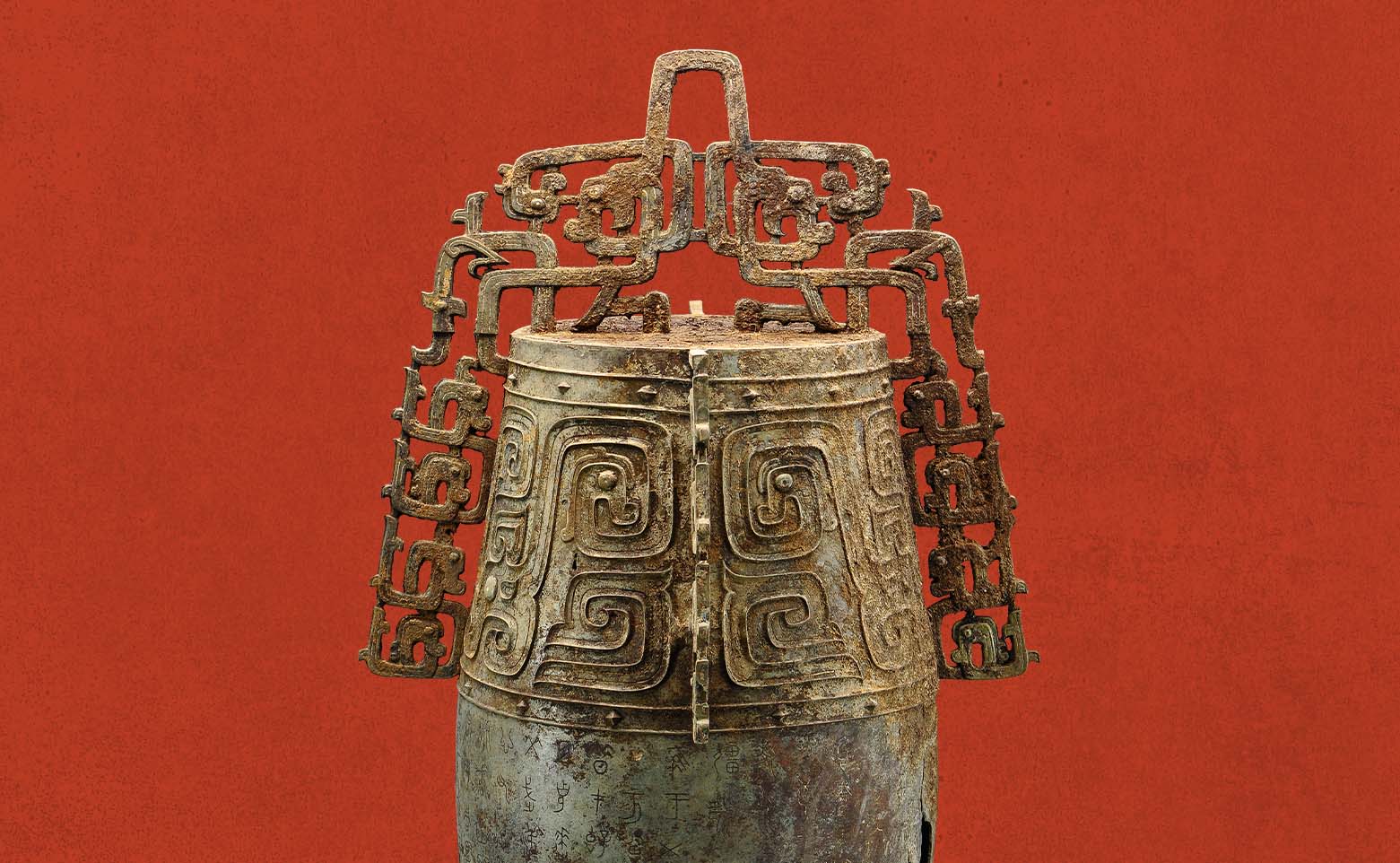
- Bo bell of Marquis Qiu of Zeng, c. 650 BCE. This magnificent bo is the largest bell in the largest known set of bells from the Spring and Autumn period. It was excavated from the tomb of Marquis Qiu of Zeng, and it features an inscription of 188 legible characters.
Loan courtesy of the Suizhou Museum - Yong bell of Marquis Yu of Zeng, c. 550–476 BCE. This monumental bronze yong is the largest of eight bells found in the tomb of Marquis Yu of Zeng. It is embellished with intricate coiled serpent motifs and a high-relief dragon design, and it features a 169-character inscription tracing the origins of the state of Zeng.
Loan courtesy of the Suizhou Museum - Painted xuangu drum with a pedestal design of phoenixes on tigers’ backs,
c. 400–300 BCE. This standing drum, supported on a pedestal formed by two phoenixes standing on the backs of two tigers, is one of the most iconic Chu instruments. It is one of the few surviving drums of its kind to retain its finely painted red and black geometric patterns.
Loan courtesy of the Xiangyang Museum - Bronze chime in animal form, c. 1300–1100 BCE. Most chimes were carved from stone; bronze examples are exceptionally rare, and only a handful survive. This remarkable specimen is said to produce multiple distinct tones, revealing the extraordinary acoustic sophistication of this early instrument.
Loan courtesy of the Changyang Museum - Stone chime with phoenix pattern, c. 475–221 BCE. This painted stone chime is part of one of the most ornate stone chime sets ever discovered. Though much of the color has faded over time, some of the chime’s striking Chu-style painting of phoenixes is
still visible.
Loan courtesy of the Hubei Provincial Museum
The exhibition also features refined objects—such as ceramic and stone artifacts depicting musicians with instruments, a suit of armor and helmet, a bronze sword, and jade pendants—that illuminate the broader cultural and aesthetic contexts these instruments were developed in. Audiovisual content provided by the Hubei Provincial Museum includes archaeological excavation footage and contemporary performance videos that bring the musical traditions of China’s ancient southern kingdoms to life.
MIM celebrates the opening weekend of Unearthed Musical Masterpieces from the Southern Kingdoms of Ancient China with a three-day Signature Event at MIM on November 6, 7, and 8. The weekend includes family-friendly activities such as curator talks, instrument demonstrations, and live music.
For information about opening weekend and other exhibition programming, visit MIM.org.
Organized by the Musical Instrument Museum and the Hubei Provincial Museum under the guidance of the National Cultural Heritage Administration of China
Selected as a 2026 “Project for the Bridge of Civilization: Premier Overseas Exhibitions
of Chinese Cultural Relics” by the National Cultural Heritage Administration of China
Exhibition presenting sponsor The Arnold Simonsen Family Charitable Foundation, Inc.
Sponsored by the John & Joan D’Addario Foundation, Jerry & Jo Ellen Preradovic,
and Scott & Catherine Roberts
The Musical Instrument Museum is located at 4725 E. Mayo Boulevard in Phoenix (corner of Tatum and Mayo Boulevards, just south of Loop 101). For general museum information and a full schedule of events, visit MIM.org or call 480.478.6000.
***
About MIM
The Musical Instrument Museum (MIM) enriches our world by collecting, preserving, and making accessible an astonishing variety of musical instruments and performance videos from every country in the world. MIM offers guests a welcoming and fun experience, incomparable interactive technology, dynamic programming, and exceptional musical performances. MIM fosters appreciation of the world’s diverse cultures by showing how we innovate, adapt, and learn from each other to create music—the language of the soul. To learn more about MIM, visit mim.org/.
Find MIM on Facebook: Facebook.com/MIMphx
Twitter, Instagram, and YouTube: @MIMphx
Media Contact
Sydney Rich
Communications Specialist
sydney.rich@MIM.org
480.245.6953
About the Hubei Provincial Museum
The Hubei Provincial Museum is located in Wuhan, the capital of Hubei Province in central China, on the middle reaches of the Yangtze River. As a National First-Class Museum and a National Key Museum jointly supported by China’s central and local governments, the museum is dedicated to preserving and promoting fine traditional Chinese culture, striving to serve as a gateway to ancient Jing-Chu culture and a vibrant center for its celebration. With a total floor area of 125,000 square meters and an exhibition area of 38,000 square meters, the museum receives more than 5 million visitors annually. It houses a collection of more than 480,000 objects, including 1,096 classified as Grade One National Cultural Relics. The Suizhou bianzhong of Marquis Yi of Zeng in its collection has been inscribed on the UNESCO Memory of the World International Register. The museum is also a National 5A-Level Tourist Attraction (the highest rating for Chinese scenic sites), a National Model Institution for Civilized Tourism, a Key Scientific Research Base of Excavated Wood and Lacquerware Conservation, National Cultural Heritage Administration, a National Key Protection Institution for Ancient Books, and a National Center for Ancient Book Restoration. In 2025, it was awarded the title of Most Innovative Museum in China.