

Registrars manage MIM’s extraordinary collection
Registrar Linda Kirsh and associate registrar Terra Smith manage MIM’s collection of more than 12,000 instruments and objects from around the world, ensuring that every piece is properly documented and cared for. By diligently stewarding each object in the collection, with expert help from other back of house teams, Linda and Terra help MIM build strong relationships with lenders, sellers, donors, and other important external contacts.

Linda Kirsh (left) and Terra Smith (right) document and manage every object in MIM’s collection.
Terra joined MIM’s Guest Service team in 2020 and earned promotions to team lead and supervisor before moving to the registration department. Linda has been working with MIM’s collection for more than 15 years, starting as a receiving coordinator before beginning her work as a registrar in 2011.
Linda and Terra coordinate logistics for MIM’s acquisitions, donations, and loans and maintain meticulous records of every object’s history, condition, and location. They write contracts, process payments, and oversee instruments when they arrive at the museum, and they safeguard MIM’s collection by making sure each object arrives at and leaves the museum safely and is properly covered under MIM’s insurance policies.
“We work behind the scenes, but we’re so connected to the other departments in the museum,” Terra says.
Shipping is a major responsibility for the registrars, who direct every object’s journey to and from MIM. Many factors affect the transportation of instruments from around the world, such as distance, environmental conditions like temperature and humidity, and international customs, laws, and restrictions. Planning each shipment requires rigorous investigation and management.
“We must be very particular about saying, ‘What is the object made of? How fragile is it? What permits might it require to ship it?’” Terra says.
“Sometimes shipping a piano is easier than shipping a guitar,” Linda says.
When coordinating shipping arrangements, the registrars must communicate carefully and clearly with dealers, donors, and lenders who speak many languages.
“There’s a lot of trust that builds over time and needs our attention with dealers, lenders, and donors,” Linda says. “When an instrument is in transit to MIM, you feel utterly responsible for it.”
Once an object arrives at the museum, one of the registrars unpacks it and checks its condition before cataloging it in the museum’s database. When loaned objects join MIM’s collection, the registrar ensures that each loan’s environmental and display requirements are met. For instance, a delicate instrument’s low light tolerance might dictate where it can be safely displayed, so the registrar works with curators, exhibit designers, and preparators to ensure that this requirement is satisfied.
“If we demonstrate that MIM treats loaned instruments with great care and respect, those lenders tell their networks, and those connections enable our curators to bring in really amazing objects,” Terra says.
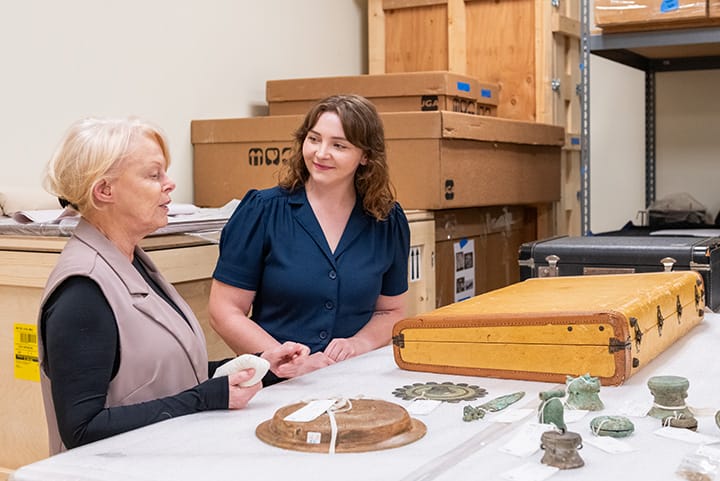
The registrars coordinate shipping arrangements for every object that enters and leaves the museum.
Linda and Terra also ensure that lenders are appropriately acknowledged while their objects are on display, and they relay museum requests on loaned instruments to lenders—for example, if the museum wants to include a loaned instrument in marketing material or if a loaned historical instrument requires treatment from MIM’s conservator.
“It’s a great responsibility and privilege to care for MIM’s collection, and it’s a wonderful feeling to see guests enjoying the instruments we helped bring to the museum,” Linda says.